Hagstrom P46 Tribute
Updated: May 2


Hagstrom was a traditional maker of accordions in Sweden and they decided to get into the guitar market in the late 1950s. Of course, they incorporated many of their accordion design features into their guitars. Things like the shiny pearloid body covering, lots of buttons, gold trim, etc.
Their initial top of the line guitar in 1958 was the Hagstrom De Luxe or P46 model. It came in a red or blue sparkle pearloid finish on the top and white pearloid on the sides, back and neck. The pickup configuration looks like two humbuckers as used on the Gibson Les Paul of the same vintage. But the Hagstrom actually had four single coil pickups selectable in various combinations using multiple buttons - just like an accordion! Some of the selections would enable the pickups to be used as humbuckers and others would use just one coil.

Over the years, their guitars would drop some of the accordion-like features to be more mainstream and attract a wider market. Some of the notable guitar players who at one time used a Hagstrom guitar included Jimi Hendrix, David Bowie, Kurt Cobain, Elvis Presley, and of course, Bjorn Ulvaeus of ABBA.
Being of Swedish heritage, I was really interested in getting the classic P46 guitar. Unfortunately, because the initial production runs were very small and the pearloid bodies easily cracked, it's really hard to find one in decent shape and they command really high prices. Even ones with body damage go for over $4,000. So I put my thinking cap on as to how to create a P46 tribute at a much lower price.
Since the body shape and pickups are similar to a Les Paul, my first thought was to buy a cheap Les Paul copy and modify it. I couldn't really find one with any sort of sparkle finish, much less a white back and neck, so that means I'd have to refinish the entire guitar. And I'd have to reshape the headstock to make it look like a Hagstrom. And I'd have to create a custom metal pickguard with the gold foil insert and the buttons and the roller wheel volume and tone controls. And then fill in the old volume and tone control knobs. And maybe add a vibrato that looks similar to the Hagstrom. I could replace the typical rosewood neck with an all maple neck to get the lighter color neck of the Hagstrom, but it would be really hard to create the really cool Hagstrom rectangular inlays to mark the frets. While I could mod a Les Paul clone for around $400, it was all the labor I'd have to put into it that soured me on this option.

My second option was to start with an Eastwood P-46 guitar. Eastwood makes some good guitars inspired by some classics that aren't made anymore. I've bought and modified a couple of their guitars before. See my articles on the Univox Ripper and Jerry Garcia's Tiger guitar. Their P-46 comes in a red or blue sparkle finish and has a vintage white back, sides and neck (no need for me to refinish the entire guitar). It has the Hagstrom headstock shape. It's got a vibrato and a custom metal pickguard that are both pretty close to the original. The red version of the Eastwood was on sale and I had accumulated Eastwood points that got me another 20% off. So overall, it cost me less than $300 more to get the Eastwood and save myself a lot of refinishing and metal work.
When the Eastwood arrived, I did all my normal set up checks and it was in better shape than almost any other guitar I've bought. No sharp fret ends, frets were nicely leveled, great tuners and the nut slots were cut at the proper depth, The intonation was just a bit off, but not by much and was easily fixed by adjusting the Tune-O-Matic bridge. The finish was perfect except for one tiny white dot where the red sparkle met the black binding which was easily fixed with a red Sharpie. The white on the side, back and neck had a slightly aged tone which I love as it looks more like the Hagstrom than Eastwood's pictures on their site.
The guitar plays well up and down the neck. The vibrato is excellent and doesn't put the guitar out of tune as many others do. While the Hagstrom had six buttons that offered many combinations, some of them weren't very useful and conflicted with each other.

The Eastwood has 4 slider switches, each turning on one of the four single coil pickups. The two pickups in the neck position are 3.5k each and the two in the bridge position are 7.5k each. Unlike the series wound pairs of pickups in a true humbucker, each of the single coils is wired in parallel to any of the other pickups. So the more pickups you choose, the lower the impedance and the lower the volume. Switching on pickups 1 + 2 (both neck pickups) doesn't give you a beefy 7k humbucker, it gives you a weaker 1.7k pair of single coils in parallel. If you roll down the tone control some, that selection gives a decent jazz/blues sound. Using just pickup 4 give a loud twangy tone like a souped up Telecaster bridge, but to my ears, a bit shrill. Pickup 3 is also loud and just bright enough to make it my favorite for leads. I like pickups 2 + 3 for rhythm, their placement relative to the string harmonics gives them a slightly out of phase effect.

But I wanted something that looked and played more like the original Hagstrom P46, so I made the following modifications to the Eastwood:
Added a metal Hagstrom sticker to the body.
Removed the volume and tone control knobs on the lower bout of the body, filling the holes and modifying the pickguard to have two Jazzmaster style thumbwheel controls for volume and tone like the original.
I also wanted more sound options, so I rewired the switches as follows: switch 1 turns neck pickup on/off, switch 2 selects the neck as a true humbucker or splits to a single coil, switch 3 turns bridge pickup on/off, switch 4 splits the bridge pickup.
Removed the Eastwood logo on the headstock and covered the headstock in red pearloid pickguard material.
Replaced the black cavity control cover on the back with a white one using white screws and stamped out a custom hagstrom heel plate.
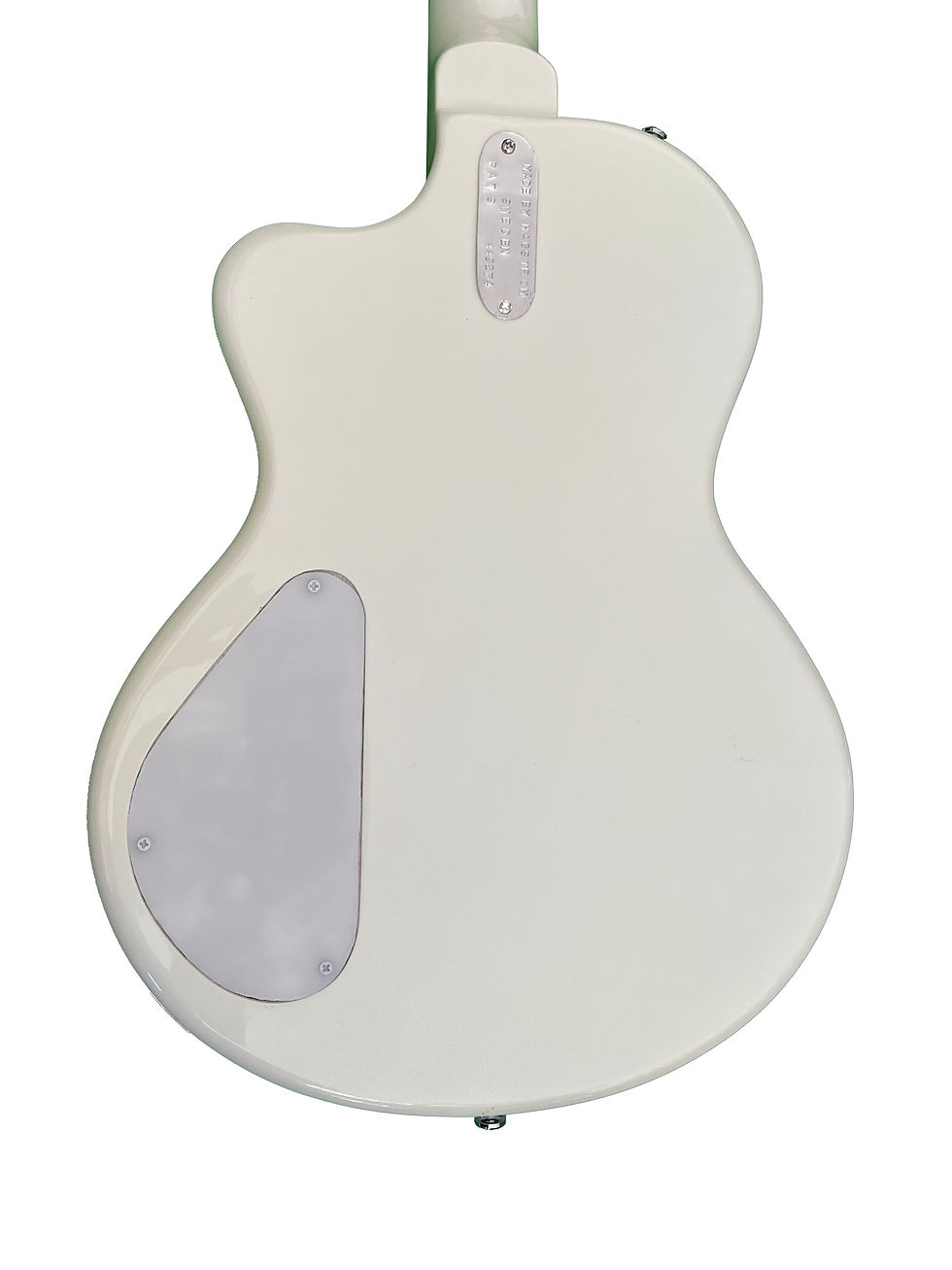
I think the final version looks a lot more like the Hagstrom. The fretboard is still rosewood instead of the original pearloid, but I know rosewood will play better and it does have the pearloid rectangular inlays.

And here's the comparison:


Comments